This guide is written by Ann, FKY's Sales Director & B2B Belt Project Consultant, for product teams sourcing custom belt programs. It offers a buyer framework, not legal, compliance or test advice; verify product-specific requirements with the appropriate professionals and evidence.
01.
Start with the use case, not the material name
Nylon and polyester are often discussed as if one is automatically better. For a custom belt buyer, that shortcut is rarely useful. The practical question is what the finished belt must feel and look like in its intended setting. A web belt for everyday carry, a tactical-inspired accessory, a travel product and a branded promotional item may have different requirements for texture, recovery, colour expression, adjustment feel and cost structure.
Write the use scenario before you choose a fibre. Include whether the product is worn daily, used over layers, paired with technical clothing, shown in close-up product photography or expected to carry a specific visual language. Then request samples of the actual weave, width and finish under consideration. Fibre name alone cannot tell you how a particular webbing construction will present in a finished belt.
- Who will wear it and in what context?
- What should the strap feel like in the hand?
- Which colours and finishes support the brand?
- What must the buckle-and-webbing path accomplish?
02.
Understand the decision factors buyers can actually inspect
A material selection meeting becomes more productive when it separates observable qualities from claims that need verification. Buyers can inspect surface texture, perceived stiffness, edge appearance, thickness, weave density, colour and the way a strap feeds through a proposed buckle. These are tangible characteristics that can be reviewed with swatches and prototypes.
For performance, testing and compliance questions, identify the applicable market and product requirements and request relevant evidence from the appropriate parties. Do not treat a generic material label as proof of a performance outcome. A clear brief creates a better path: specify what needs to be validated, how an approval sample will be compared and who will make the final acceptance decision.
03.
Choose the webbing character for the belt silhouette
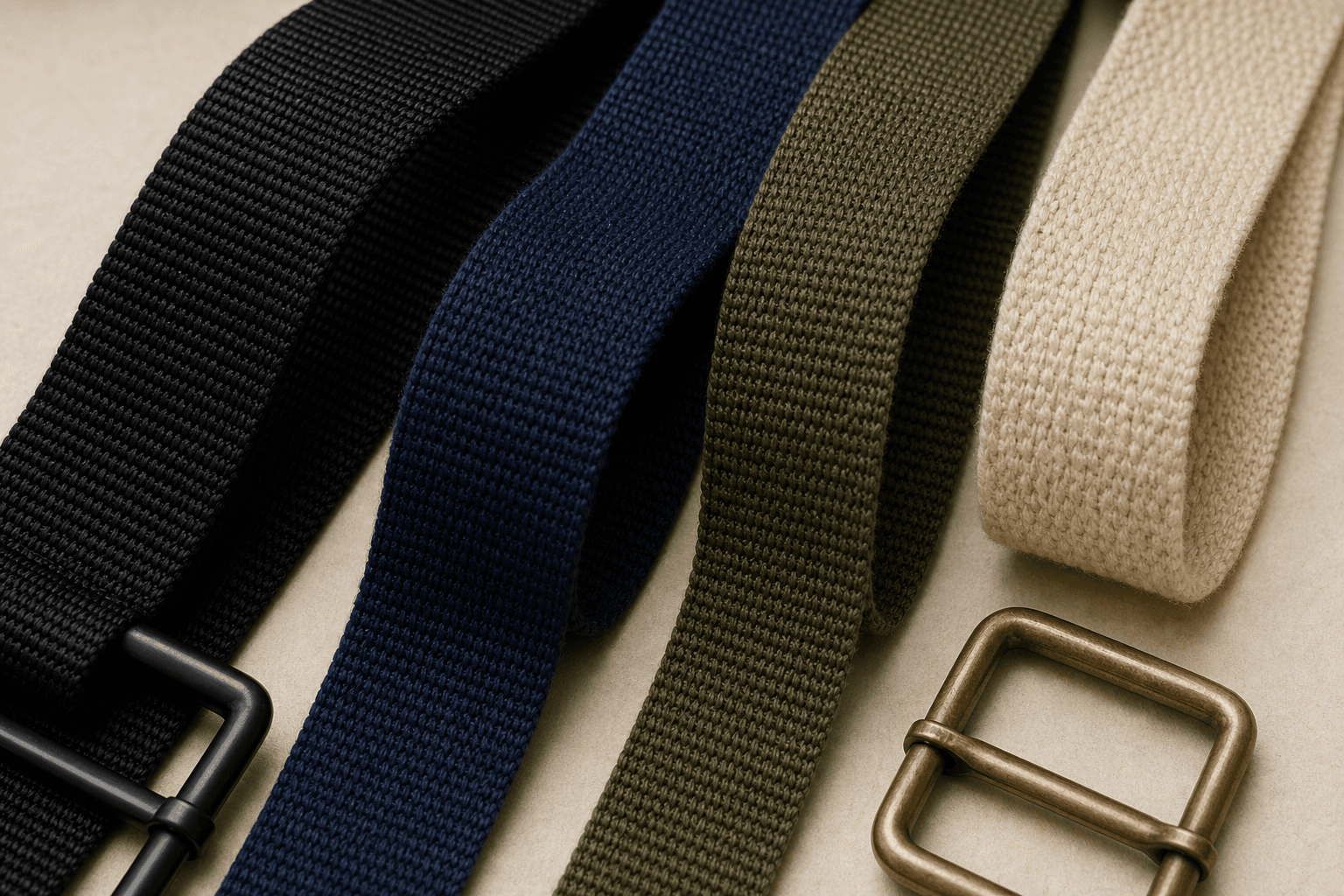
The same width can communicate very different things depending on the weave and finish. A smooth, tightly woven strap can read clean and technical. A more visible woven texture can add utility or outdoor character. A softer, more textile-led surface may fit casual or lifestyle programs. None of these directions is universally correct; they should reinforce the product’s story and the buckle’s visual weight.
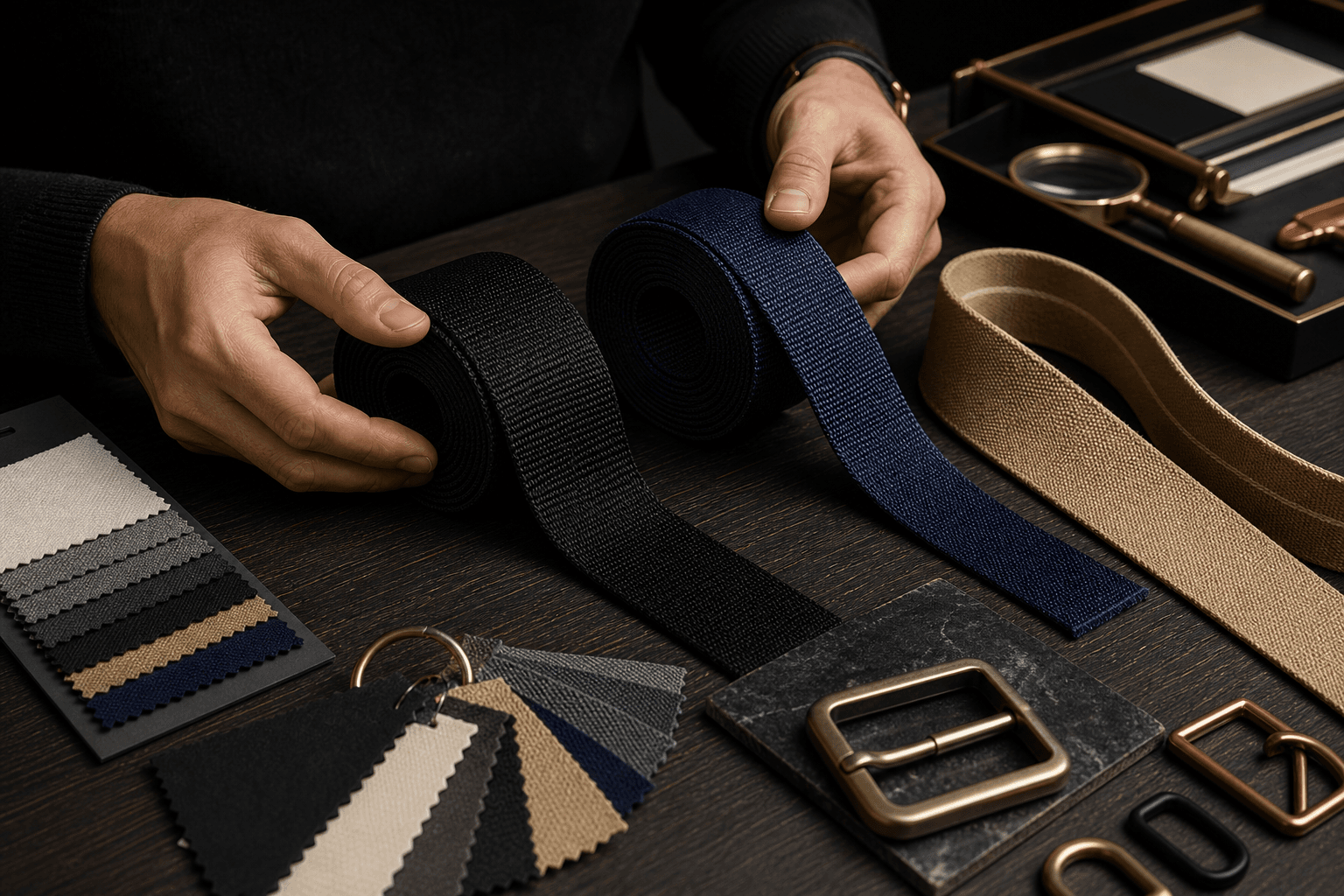
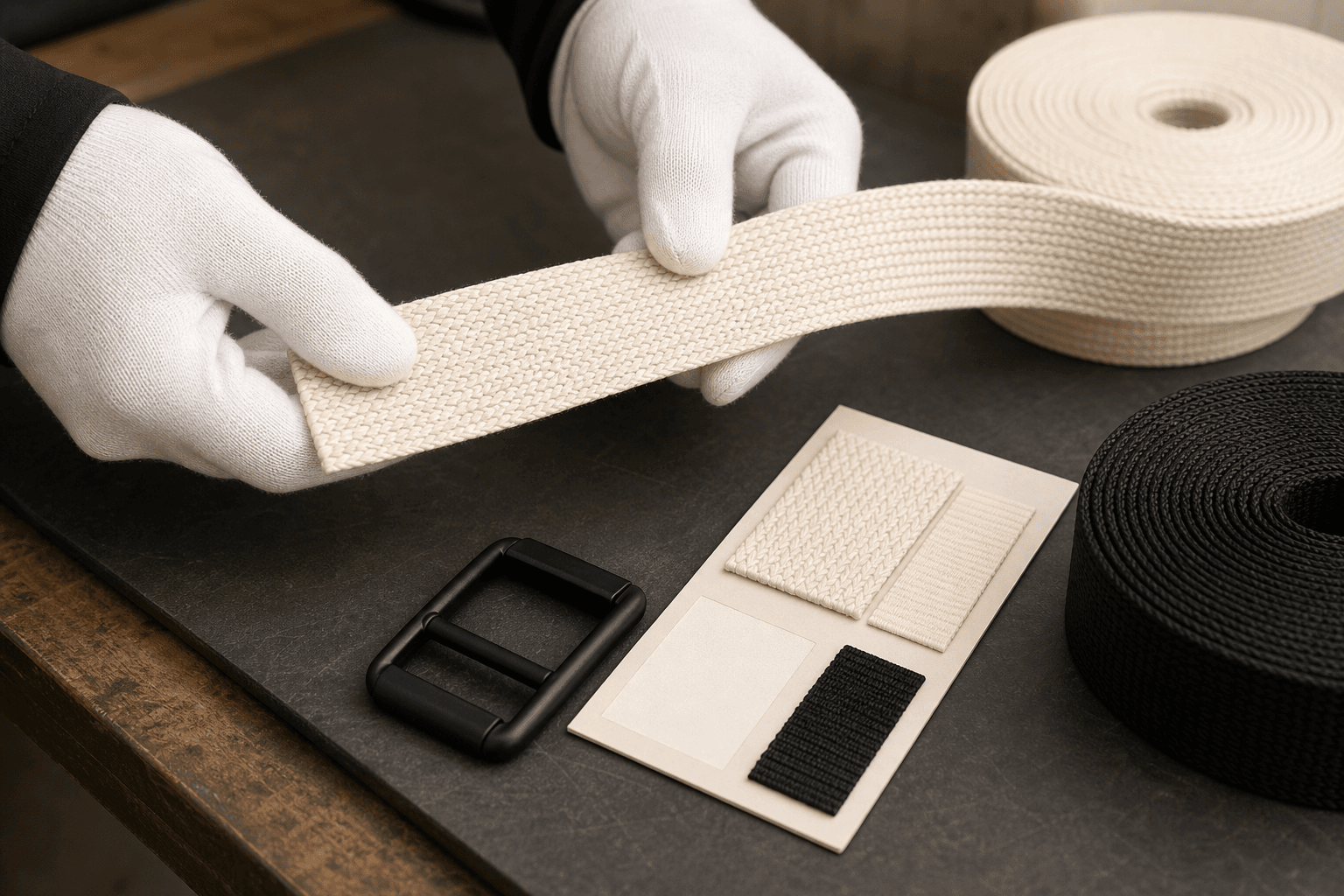
Lay material swatches beside the proposed buckle, keeper and label. Look at the combination in natural and studio light. A buyer should ask whether the strap makes the hardware look intentional, whether edges appear suitably refined, and whether the assembled product holds its visual balance. This is particularly important for online retail, where close-up imagery magnifies small material choices.
04.
Make colour and branding a material decision
Colour planning is not an afterthought. A custom belt may combine coloured webbing, coated or plated hardware, woven labels, printed packaging and digital product imagery. Use a named reference or approved swatch where possible, and write down what the approval covers. If a collection will include several colours, discuss how the team will review consistency across the range rather than approving one sample in isolation.
Branding details should also be viewed on the chosen surface. A mark that is clear on a smooth label may behave differently on a textured woven strap. Ask for the proposed placement and scale in the sample stage and make sure the approval pack records the actual chosen method.
05.
Check the webbing with the adjustment method
A belt is used through its adjustment path. Thread the sample through the intended buckle, pull it to the expected fit, release it and repeat. Notice any friction, slippage, twisting or visual bunching. These observations do not substitute for a formal test programme, but they help a buying team detect incompatibilities early and frame specific questions for the supplier.
Where the program has a critical functional requirement, define it in the brief and agree on how it will be evaluated. The most valuable output is not a vague assurance; it is a shared method for reviewing the finished configuration.
06.
Build a sample set that supports a real decision
Instead of ordering unrelated samples, request a focused comparison set: the same belt construction in two or three webbing directions, with the same buckle where practical. Photograph them, note perceived hand feel and measure the details your brief requires. Review the set with people who understand brand, merchandising and product requirements so the choice reflects the market rather than one person’s preference.
Record what you selected and why. A short statement such as ‘chosen for a clean technical surface and intended buckle pairing’ is more useful for later teams than a bare material name. It preserves design intent when the collection expands or a future team revisits the product.
07.
Turn selection into a production-ready instruction
Once the direction is approved, lock the identification details that distinguish the chosen webbing: reference sample, colour reference, width, weave or finish description, expected edge appearance and its relationship to the buckle. Attach approved photographs to the instruction. The goal is not to create unnecessary paperwork; it is to protect the specific decision your team made.
If information is still unavailable, state that it is pending. Honest gaps are safer than invented precision. A buyer can then plan the next sample or verification stage around the decisions that remain open.
FAQ
Buyer questions, answered.
Is nylon or polyester always better for belts?
No. The suitable choice depends on the actual webbing construction, target use, desired appearance, adjustment system and your validation requirements.
What should I compare in samples?
Compare surface texture, edge appearance, hand feel, colour, thickness and how each sample works with the proposed buckle.
Can I use multiple webbing directions in one collection?
Yes. Document the design rationale and approval reference for each SKU so the product system stays consistent.
PRODUCT LINKS
Continue with a relevant product or development page.
Ready to source?